Sunday, 22 November 2015

Seventh Pay Commission Report, 2015


In a resolution dated 28th February, 2014, 


Government of India has appointed the Seventh Central Pay Commission comprising
  • Justice Shri Ashok Kumar Mathur as Chairman,
  • Shri Vivek Rae as full time Member,
  • Dr. Ratin Roy as part time Member and
  • Smt. Meena Agarwal as Secretary.

Following are the highlights of the recommendations made by the 7th Central Pay 

Commission, 

headed by Justice A K Mathur,

 which submitted its report to Finance Minister Arun Jaitley : -

Recommended Date of implementation: 01.01.2016

  • Minimum Pay: Based on the Aykroyd formula, the minimum pay in government is recommended to be set at ₹18,000 per month.
  • Maximum Pay: ₹2,25,000 per month for Apex Scale and ₹2,50,000 per month for Cabinet Secretary and others presently at the same pay level.
Financial Implications:
  • The total financial impact in the FY 2016-17 is likely to be ₹1,02,100 crore, over the expenditure as per the ‘Business As Usual’ scenario. Of this, the increase in pay would be ₹39,100 crore, increase in allowances would be ₹ 29,300 crore and increase in pension would be ₹33,700 crore.
  • Out of the total financial impact of ₹1,02,100 crore, ₹73,650 crore will be borne by the General Budget and ₹28,450 crore by the Railway Budget.
  • In percentage terms the overall increase in pay & allowances and pensions over the ‘Business As Usual’ scenario will be 23.55 percent. Within this, the increase in pay will be 16 percent, increase in allowances will be 63 percent, and increase in pension would be 24 percent.
  • The total impact of the Commission’s recommendations are expected to entail an increase of 0.65 percentage points in the ratio of expenditure on (Pay+Allowances+ Pension) to GDP compared to 0.77 percent in case of VI CPC.
  • New Pay Structure: Considering the issues raised regarding the Grade Pay structure and with a view to bring in greater transparency, the present system of pay bands and grade pay has been dispensed with and a new pay matrix has been designed. Grade Pay has been subsumed in the pay matrix. The status of the employee, hitherto determined by grade pay, will now be determined by the level in the pay matrix.Fitment: A fitment factor of 2.57 is being proposed to be applied uniformly for all employees.
  • Annual IncrementThe rate of annual increment is being retained at 3 percent.

Modified Assured Career Progression (MACP):

  • Performance benchmarks for MACP have been made more stringent from “Good” to “Very Good”.
  • The Commission has also proposed that annual increments not be granted in the case of those employees who are not able to meet the benchmark either for MACP or for a regular promotion in the first 20 years of their service.
  • No other changes in MACP recommended.
  • Military Service Pay (MSP), which is a compensation for the various aspects of military service, will be admissible to the defence forces personnel only * MSP for service officers more than doubled to Rs. 15,500 per month from Rs. 6,000 currently; for nursing officers to Rs. 10,800 from Rs. 4,200; for JCO/ORs to Rs. 5,200 from Rs. 2,000 and for non—combatants to Rs. 3,600 from Rs. 1,000 *
  • Short service commissioned officers will be allowed to exit the armed forces at any point in time between 7 to 10 years of service, with a terminal gratuity equivalent of 10.5 months of reckonable emoluments. They will further be entitled to a fully funded one year Executive Programme or a M.Tech. programme at a premier Institute.
  • Commission recommends abolishing 52 allowances; another 36 allowances subsumed in existing allowances or in newly proposed allowances.
  • Lateral Entry/Settlement: The Commission is recommending a revised formulation for lateral entry/resettlement of defence forces personnel which keeps in view the specific requirements of organization to which such personnel will be absorbed. For lateral entry into CAPFs an attractive severance package has been recommended.


Headquarters/Field Parity: 
  • Parity between field and headquarters staff recommended for similar functionaries e.g Assistants and Stenos.


Cadre Review:
  • Systemic change in the process of Cadre Review for Group A officers recommended.


Allowances: 
  • The Commission has recommended abolishing 52 allowances altogether. Another 36 allowances have been abolished as separate identities, but subsumed either in an existing allowance or in newly proposed allowances. Allowances relating to Risk and Hardship will be governed by the proposed Risk and Hardship Matrix.


Risk and Hardship Allowance: 
  • Allowances relating to Risk and Hardship will be governed by the newly proposed nine-cell Risk and Hardship Matrix, with one extra cell at the top, viz., RH-Max to include Siachen Allowance.


House Rent Allowance: 
  • Since the Basic Pay has been revised upwards, the Commission recommends that HRA be paid at the rate of 24 percent, 16 percent and 8 percent of the new Basic Pay for Class X, Y and Z cities respectively. The Commission also recommends that the rate of HRA will be revised to 27 percent, 18 percent and 9 percent respectively when DA crosses 50 percent, and further revised to 30 percent, 20 percent and 10 percent when DA crosses 100 percent.
  • In the case of PBORs of Defence, CAPFs and Indian Coast Guard compensation for housing is presently limited to the authorised married establishment hence many users are being deprived. The HRA coverage has now been expanded to cover all.
  • Any allowance not mentioned in the report shall cease to exist.
  • Emphasis has been placed on simplifying the process of claiming allowances.


Advances:

  • All non-interest bearing Advances have been abolished.
  • Regarding interest-bearing Advances, only Personal Computer Advance and House Building Advance (HBA) have been retained. HBA ceiling has been increased to ₹25 lakhs from the present ₹7.5 lakhs.
  • Central Government Employees Group Insurance Scheme (CGEGIS): The Rates of contribution as also the insurance coverage under the CGEGIS have remained unchanged for long. They have now been enhanced suitably. See Table for the following rates of CGEGIS recommended:


Medical Facilities:

  • Introduction of a Health Insurance Scheme for Central Government employees and pensioners has been recommended.
  • Meanwhile, for the benefit of pensioners residing outside the CGHS areas, CGHS should empanel those hospitals which are already impaneled under CS (MA)/ECHS for catering to the medical requirement of these pensioners on a cashless basis.
  • All postal pensioners should be covered under CGHS. All postal dispensaries should be merged with CGHS.


Pension
  • The Commission recommends a revised pension formulation for civil employees including CAPF personnel as well as for Defense personnel, who have retired before 01.01.2016. This formulation will bring about parity between past pensioners and current retirees for the same length of service in the pay scale at the time of retirement.
  • The past pensioners shall first be fixed in the Pay Matrix being recommended by the Commission on the basis of Pay Band and Grade Pay at which they retired, at the minimum of the corresponding level in the pay matrix.
  • This amount shall be raised to arrive at the notional pay of retirees, by adding number of increments he/she had earned in that level while in service at the rate of 3 percent.
  • In the case of defence forces personnel this amount will include Military Service Pay as admissible.
  • Fifty percent of the total amount so arrived at shall be the new pension.
  • An alternative calculation will be carried out, which will be a multiple of 2.57 times of the current basic pension.
  • The pensioner will get the higher of the two.


Gratuity:
  • Enhancement in the ceiling of gratuity from the existing ₹10 lakh to ₹20 lakh. The ceiling on gratuity may be raised by 25 percent whenever DA rises by 50 percent.


Disability Pension for Armed Forces
  • The Commission is recommending reverting to a slab based system for disability element, instead of existing percentile based disability pension regime.
  • Ex-gratia Lump sum Compensation to Next of Kin: The Commission is recommending the revision of rates of lump sum compensation for next of kin (NOK) in case of death arising in various circumstances relating to performance of duties, to be applied uniformly for the defense forces personnel and civilians including CAPF personnel.
  • Martyr Status for CAPF Personnel: The Commission is of the view that in case of death in the line of duty, the force personnel of CAPFs should be accorded martyr status, at par with the defense forces personnel.


New Pension System: 
  • The Commission received many grievances relating to NPS. It has recommended a number of steps to improve the functioning of NPS. It has also recommended establishment of a strong grievance redressal mechanism.


Regulatory Bodies
  • The Commission has recommended a consolidated pay package of ₹4,50,000 and ₹4,00,000 per month for Chairpersons and Members respectively of select Regulatory bodies. In case of retired government servants, their pension will not be deducted from their consolidated pay. The consolidated pay package will be raised by 25 percent as and when Dearness Allowance goes up by 50 percent. For Members of the remaining Regulatory bodies normal replacement pay has been recommended.


Performance Related Pay: 
  • The Commission has recommended introduction of the Performance Related Pay (PRP) for all categories of Central Government employees, based on quality Results Framework Documents, reformed Annual Performance Appraisal Reports and some other broad Guidelines. The Commission has also recommended that the PRP should subsume the existing Bonus schemes.


There are few recommendations of the Commission 

where there was no unanimity of view and these are 

as follows:

The Edge:
  •  An edge is presently accorded to the Indian Administrative Service (IAS) and the Indian Foreign Service (IFS) at three promotion stages from Senior Time Scale (STS), to the Junior Administrative Grade (JAG) and the NFSG. is recommended by the Chairman, to be extended to the Indian Police Service (IPS) and Indian Forest Service (IFoS).
  • Shri Vivek Rae, Member is of the view that financial edge is justified only for the IAS and IFS. Dr. Rathin Roy, Member is of the view that the financial edge accorded to the IAS and IFS should be removed.


Emplacement: 
  • The Chairman and Dr. Rathin Roy, Member, recommend that All India Service officers and Central Services Group A officers who have completed 17 years of service should be eligible for emplacement under the Central Staffing Scheme and there should not be “two year edge”, vis-à-vis the IAS. Shri Vivek Rae, Member, has not agreed with this view and has recommended review of the Central Staffing Scheme guidelines.
  • Non Functional Up-gradation for Organised Group ‘A’ Services: The Chairman is of the view that NFU availed by all the organised Group `A’ Services should be allowed to continue and be extended to all officers in the CAPFs, Indian Coast Guard and the Defense forces. NFU should henceforth be based on the respective residency periods in the preceding substantive grade. Shri Vivek Rae, Member and Dr. Rathin Roy, Member, have favored abolition of NFU at SAG and HAG level.


Superannuation:

 Chairman and Dr. Rathin Roy, Member, recommend the age of superannuation for all CAPF personnel should be 60 years uniformly. 
Shri Vivek Rae, Member, has not agreed with this recommendation and has endorsed the stand of the Ministry of Home Affairs.


The full report is available in the website, http://7cpc.india.gov.in

Wednesday, 8 April 2015

MUDRA Launch by PM Shri Narendra Modi today

Prime Minister Narendra Modi on 8 April 2015 launched Micro Units Development Re-finance Agency (MUDRA) Bank in New Delhi. 
MUDRA Bank will act as a regulator for ‘Micro-Finance Institutions’ (MFIs) involved in manufacturing, trading and service activities to promote their growth. 

The Pradhan Mantri MUDRA Yojana will be the main support system for the bank and will be the part of Small Industries Development Bank of India (SIDBI). 

The MUDRA bank was proposed in Budget 2015-16 by Union Government with an initial corpus of 20,000 crore rupees. Apart from this, 3,000 crore rupees also has been earmarked as credit guarantee corpus. 

The envisaged roles for MUDRA Bank include Formulate policy guidelines for micro-enterprise financing business and registration of MFI entities. 
Undertake rating and accreditation of MFI entities. 

Develope standardized set of guidelines in order to govern last-mile lending to micro enterprises. Promote appropriate technology solutions for the last mile.
 Formulate and operate a credit guarantee schemes in order to provide guarantees to loans and portfolios that are extended to micro enterprises.

 Support promotional and development activities in the sector and create a good architecture for last-mile credit delivery. 
MUDRA Bank will provide financing on 3 stages- Shishu, Kishore and Tarun. 

Shishu is first stage in which loan cover upto Rs 50,000 will be given to a business entity at start of business. 

Kishore is second stage in which loan cover ranging from Rs 50,000 to Rs 5 lakh will be given. Tarun is the third stage in which loan cover up to Rs. 10 lakh will be given

Tuesday, 24 March 2015

Kisan Vikas Patra Yojna (KVPY) 2014

Kisan Vikas Patra Yojna has been relaunched by Government of India on 18th November,2014. The Kisan Vikas Patra scheme was originally launched in April, 1988 but was discontinued in 2011. This was a very popular financial product among the lower and middle income group. 
Kisan vikas patra

Main Features of Kisan Vikas Patra are:

  • Safe investment scheme  for small income group.
  • The scheme will give you annual return of 8.67 %. Interest is compounded annually.
  • Your investment will be doubled in 100 months or in 8 years 4 months.
  • You can purchase this scheme from a post office. Soon this will be made available in Nationalized Banks too.
  • The re-launched KVP will be available in the denomination of Rs 1,000, 5,000, 10,000 and 50,000, without an upper ceiling on investment.
  • KVP certificates can be bought in single or joint names.
  • You can pledge KVP certificates as security to avail loans from banks
  • Only individuals can invest in KVP. You can invest on behalf of a minor too. But Companies, NRIs, HUFs etc., can not buy these certificates.
  • Nomination facility is available on KVP.
  • You can transfer kisan vikas patra certificates from one post office to another one, anywhere in India
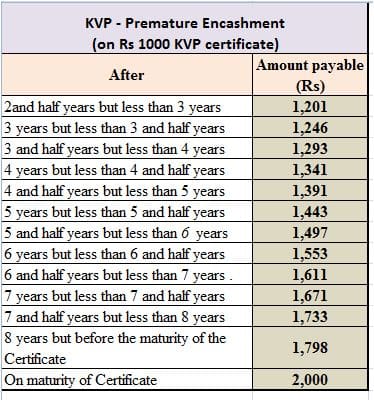
  • There is a lock-in period of 2 years and 6 months. After 2.5 years and thereafter in any block of six months  you can encash the certificates. Redemption will be at pre-determined maturity values
  • Interest on KVP will be taxed at 10% TDS ( if you are in different income tax slab then you have to club to your income and file Income tax returns accordingly)
  • KYC (Know Your Customer) rules are applicable on your KVP investments. You have to submit required documents while investing in KVP.
Premature Encashment of KVP & Amount Payable
Premature Encashment or withdrawal of KVP certificates will be at pre-determined maturity values as below.KVP premature enchashmentTo invest or not to invest in Kisan Vikas Patra? (KVP vs Bank Fixed Depostis)
  • The current  interest rates on bank fixed deposits for 8 year term are around 8.5% (around 9% for senior citizens). We can soon expect reduction in interest rates by RBI in the coming quarters. Even if RBI reduces interest rates, the expected annual yield on Kisan Vikas patra which is 8.67%  is not a great return on investment. (You may like visiting my post on “information on RBI rates.”)
  • Also, investments in KVP are not eligible for any tax benefits under Section 80c. If you really want to invest in a safe investment avenue then you can book a 5 year Bank Fixed deposits and get tax benefits too.
  • KVP does not have tax benefits and Lock-in period is applicable.
  • Consider investing in Public Provident Fund (15 years lock-in will be there) if safety is your priority.
  • You can consider investing in National Savings Certificate (NSC – 5 years) which is available at 8.5% interest rate. Also, it has tax benefits too (under section 80c)
Do not just buy Kisan Vikas Patra as it is a safe investment option and promoted by the Government. Before buying KVP certificates, identify your investment requirements first and then compare KVP scheme with other similar investment avenues like Bank fixed deposits, Post office NSC/PPF etc., (I will try to update this post with more details ..Cheers!)

Monday, 23 March 2015

Sukanya Samriddhi Account – Govt’s Special Scheme for Girl child – Features, Review & Benefits


Sukanya Samriddhi Account (SSA) along with ‘Beti Bachao-Beti Padhao’ (BBB) will be officially launched on 22nd January, 2015. These schemes will be introduced by our honorable Prime Minister Narendra Modi.
Sukanya Samriddhi Account/Yojana is a Small Savings Special deposit Scheme for girl child. This scheme is specially designed for girl’s higher education or marriage needs.
Finance Minister Arun Jaitley had announced this scheme in his budget speech in July. The gazette on this scheme was released on 2nd December, 2014. On 21st January, 2015 the finance ministry released a notification with respect to the applicable interest rate on Sukanya Samriddhi Account.
Let us understand the features and benefits of Sukanya Samriddhi Account Special Savings deposit scheme.
Girl child Sukanya Samriddhi Account

Features of Sukanya Samriddhi Account (SSA):

  • Who can open the account? – Sukanya Samriddhi a/c (or Khata) can be opened on a girl child’s name by her natural (biological) parents or legal guardian.
  • What is the Age limit? – SSA can be opened in the name of a girl child from the birth of the girl child till she attains the age of ten years. (Girl child who is born on or after 02-12-2003 can open SSA/SSY account).
  • How many accounts can be opened? – A depositor may open and operate only one account in the name of same girl child under this scheme. The depositor (or) guardian can open only two SSA accounts. There is one exception to this rule. The natural or legal guardian can open two or three accounts if twin girls are born as second birth or triplets are born in the first birth itself.
  • How to open a SSA account (Sukanya Savings Account opening procedure)? Accounts in name of the girl child can be opened in post offices or in any branch of a commercial bank that is authorized by the Central Government to open an account under this scheme rules. As of now, the list is not drawn and many government owned banks are still in the process of completing formalities to open the Sukanya Samriddhi Yojana (SSY) Account, you may visit any of the government banks for the purpose of opening the account. (Some of these banks include – State Bank of India (SBI), SBH, Bank of Baroda, Punjab National Bank, Bank of India, Canara Bank, Andhra Bank, UCO Bank, Allahabad Bank, Corporation Bank etc.,)
  • What is the minimum deposit to open the account? – The account may be opened with an initial deposit of one thousand rupees. The minimum contribution in any financial year is Rs 1000. Thereafter the contributions can in multiples of one hundred rupees.
  • What is the maximum deposit amount? – a minimum of one thousand rupees shall be deposited in a financial year but the total money deposited in an account on a single occasion or on multiple occasions shall not exceed Rs 1.5 Lakh in a financial year.
  • Deposits/contributions in an account may be made for  fourteen years from the date of opening of the account.
  • Is there any penalty? – If minimum (Rs 1000 pa) amount is not deposited, the account will be treated as an irregular account. This can be regularized/renewed on payment of Rs 50 per year as penalty. Along with this, the minimum specified subscription for the year (s) of default should be paid.
  • What is the mode of deposit? – The deposits in Sukanya Samruddhi scheme can be made in the form of Cash or Demand Draft or Cheque. Where deposit is made by cheque or demand draft, the date of encashment of the cheque or demand draft shall be the date of credit to the account. The cheque or DD should be drawn in favour of the postmaster of the concerned post office or the Manager of the concerned bank.The depositor (parents or guardian) has to write the account holder’s name (child’s name) and the account number on the backside of the instrument.
  • What is the Rate of Interest on Sukanya Samriddhi Account? – The applicable rate of interest on SSA for the financial year 2014-2015 is 9.1%. This is one of the highest rates of interest offered by Government on small savings scheme
  • Is interest rate fixed or variable? – The rate of interest is not fixed and will be notified by the central government on a yearly basis.
  • The account can be transferred anywhere in India if the girl shifts to a place other than the city or locality where the account stands.
  • Is Premature withdrawal allowed? – 50 % (half of the fund) of the accumulated amount in SSA can be withdrawn for girl’s higher education and marriage after she attains 18 years of age. The account’s balance at the end of preceding financial year is used for the calculation.
  • Can the girl child operate the account? On attaining age of ten years, the account holder that is the girl child may herself operate the account, however, deposit in the account may be made by the guardian or parents.
  • Is premature closure allowed? In the event of death of the account holder, the account shall be closed immediately on production of death certificate. the balance at the credit of the account shall be paid along with interest till the month preceding the month of premature closure of the account , to the guardian of the account holder.
  • The scheme would mature on completion of 21 years from the date of opening of the account, with an option of keeping the account till marriage. So, the maturity of the account is 21 years from the date of opening of account or if the girl gets married before completion of such 21 years (whichever is earlier).
  • Can the girl child continue the account after her marriage? – The operation of the account shall not be permitted beyond the date of the girl’s marriage.
  • What are the required documents to open Sukanya Samriddhi Account? – Birth certificate of the girl child has to be produced. The depositor (parents or guardian) has to submit his/her identity and address proofs.
  • Download Sukanya Samriddhi Account/Yojana (SSA/SSY) Application form. (This SSA applicaiton form that can be submitted at Post office. Download the file by clicking on the below image and go to ‘Form 1′ Post office Savings Bank page and you can take print out of the same)SSA Application Form
  • On opening an account, the depositor shall be given a pass book. It will have date of birth of the girl child, date of opening of account, account number, name and address of the account holder and the initial amount deposited. The depositor has to present the passbook to the post office or bank at the time of depositing/receiving the interest/on maturity.
Income Tax Benefits on Sukanya Samriddhi Account Scheme – Section 80c
The amount that is deposited under Sukanya Samriddhi Account will be eligible for income tax exemption under Section 80C of Income Tax Act, 1961.
At present, only the contribution of up to Rs 1.5 lakh toward Sukanya Samridhi Yojana is eligible for tax deduction under Section 80C. The maturity amount (withdrawal amount) is exempted from income tax.
But discussions are on to also exempt the interest income. We can expect a formal announcement on this in the coming Union Budget 2015-16.
(Issue of making interest income exempt from taxation can be done by Department of Revenue (DoR) through legislative amendments. The matter is under examination of DoR)

Latest News : As per Budget 2015, all the payments under Sukanya Samriddhi Account / Yojana Deposit Scheme are exempted from Income Tax. So, Deposits made under SSA Khata / account are exempted under Section 80C. The interest amount and maturity amount (withdrawals) are also exempted from Income Tax. So, investments in SSA falls under Exempt – Exempt – Exempt (EEE) tax category.


PPF Account (Public Provident Fund) Vs Sukanya Samriddhi Account
PPF (Public Provident Fund) has E-E-E tax rule. As per this rule – contributions, accumulation (interest amount) and withdrawal are all exempted from income tax.
 There is a high chance thatSukanya Samruddhi Account may be brought under E-E-E catergory(As of now there is no official confirmation on this. Let us wait for more information).
For the fiscal year 2014-2015 the rate of interest on PPF account is 8.70% (upto March 2015). OnSukanya Samruddhi Account this is 9.10%. So, comparatively SSA has higher rate of interest. The interest on SSA will be calculated just like the way it is done on PPF a/c.
Sukanya Samridhi Account – Interest Amount & Maturity Amount Calculation:
You may have few questions like : How is the interest amount calculated on Sukanya Samridhi Savings scheme? – What could be the total maturity amount on SSA Savings account? What is the total interest amount that I can earn on SSA?
Before proceeding with the calculations, below are the main points/assumptions with respect to interest and maturity amount calculations:
  • The contributions are allowed upto 14 years from SSA account opening date.
  • The SSA savings account can be operated till the completion of 21 years from the account opening date.
  • The current applicable interest rate on SSA scheme is 9.1% (this rate of interest will vary in future, as per the Central Government’s future notifications.)
  • The interest on SSA will be calculated just like the way it is done on PPF a/c. (PPF interest is calculated monthly on the lowest balance between the end of the 5th day and last day of month, however the total interest in the year is added back to PPF only at the year-end.)
  • I have assumed the investments are done at the beginning of every month/year and calender year as April-March.
Sukanya Samriddhi Account/Yojna – Interest & Maturity amount calculation - Scenario 1-Monthly Deposit
Example 1 - Mr Aravind Swamy wants to open the Sukanya Samridhi Savings account in the name of his girl’s child (5 years old) in April 2015. He wants to contribute Rs 10,000 every month for 14 years. He also wants to keep this account active till 21 years from the account opening date (or till Child’s age of 25 years). He wants to know, what could be the total approximate interest amount and total maturity amount that he would accumulate under SSA?
Interest Calculation  Sukanya Samriddhi Account - Monthly contribution
As per above calculations, Mr Aravind Swamy can accumulate total interest amount to the tune of Rs 45.73 Lakh. The total maturity amount on his SSA savings account can be Rs 62.53 Lakh. He also has the option to withdraw 50% of Rs29.89 Lakh when his child turns 18 years. (If he withdraws, the total maturity amount will not be as shown above.)
The present value (PV) of Rs 62.53 Lakh (maturity amount ) is Rs 8.45 Lakh, assuming 10% as Education inflation (the rate at which education/marriage expenses may increase). Kindly think from this angle too.
Sukanya Samriddhi Account/Yojna – Interest & Maturity amount calculation – Scenario 2 – Yearly Deposit
Example 2 - Mr Madhavan wants to open the Sukanya Samridhi Savings account in the name of his girl’s child (5 years old) in April 2015. He wants to contribute Rs 1,20,000 every year for 14 years. He also wants to keep this account active till 21 years from the account opening date (or till Child’s age of 25 years). He wants to know, what could be the total approximate interest amount and total maturity amount that he would accumulate under SSA?
Interest Calculation  Sukanya Samriddhi Account - Yearly contribution
As per the above calculations, Mr Madhavan can accumulate total interest amount to the tune of Rs 46.32 Lakh. The total maturity amount on his SSA savings account can be Rs 63.12 Lakh. He also has the option to withdraw 50% of Rs 30.24 Lakh when his child turns 18 years. (If he withdraws, the total maturity amount will not be as shown above.)
Kindly note the difference in the maturity amounts between the ‘monthly contribution account’ and ‘yearly contribution account.’
My opinion on Sukanya Samriddhi Account Savings Scheme:
I can confidently say that the average rate of education inflation in India is somewhere around 10% to 15%. The rate at which marriage expenses are increasing is also very high.
Given this scenario, the 9.10% rate of interest may not beat the inflation. Unlike Bank fixed deposits, this rate of interest is not fixed.
The better way to create sufficient corpus for a Child’s education is to allocate major portion of savings to equity related instruments (if you have more than 10 years time frame). You can then consider investing small portion of your savings towards this scheme. This scheme can be considered as the DEBT component of your investment portfolio.
Another drawback of SSA is the number of accounts that can be operated. The number of accounts that are allowed to open under this scheme is limited to two accounts only. Parents of more than two girls can not open multiple Sukanya Samriddhi Accounts.

Thursday, 5 February 2015

Beti bachao beti padhao campaign -Never Give Up

जो व्यक्ति गर्भ में
बेटियों की हत्या करते हैं उनके
लिए यह बात है. हमेशा याद रखना...
.
.
अगर बेटा वारिस है, तो बेटी पारस है |
अगर बेटा वंश है, तो बेटी अंश है |
अगर बेटा आन है, तो बेटी शान है |
अगर बेटा तन है, तो बेटी मन है |
अगर बेटा मान है, तो बेटी गुमान है |
अगर बेटा संस्कार, तो बेटी संस्कृति है |
अगर बेटा आग है, तो बेटी बाग़ है |
अगर बेटा दवा है, तो बेटी दुआ है |
अगर बेटा भाग्य है, तो बेटी विधाता है |
अगर बेटा शब्द है, तो बेटी अर्थ है |
अगर बेटा गीत है,
तो बेटी संगीत है |
जाने कितनी परियों ने
मिल,अर्जियां दी थी,
तब खुदा ने दुनिया को ये,
बेटियाँ दी थी..!!
**कौन कहता है कि गिद्ध नहीं बचे हैं अब
हिन्दोस्तान मे,
.
.
.
.
***रोज सड़कों पर लाखों की नजरे
  • टिकी होती हैं मासूम चिडियाओं पर!!!